AI Ethics and Privacy in Education: Protecting Student Data While Leveraging AI
How to build ethical AI systems for education that protect student privacy, comply with FERPA and COPPA, and maintain transparency without sacrificing innovation. A comprehensive guide covering data minimization, consent, bias mitigation, and regulatory compliance from 20 years building EdTech platforms.
Introduction
AI in education promises personalized learning, automated grading, early intervention for struggling students, and administrative efficiency. But educational institutions hold some of the most sensitive personal data: academic performance, learning disabilities, disciplinary records, family information, and for minors, data protected under the most stringent privacy laws in the United States.
The tension is real: AI systems need data to function effectively, but educational data is legally and ethically protected in ways that consumer data is not. A recommendation algorithm that works brilliantly for Netflix becomes legally problematic when applied to students. An AI tutor that adapts to learning patterns must do so without creating permanent records that follow a student through their academic career.
After 20 years building AI and educational software for institutions serving millions of students, we've learned that ethical AI in education is not about choosing between innovation and privacy; it's about architecting systems that deliver both. This post covers how to do exactly that.
The Regulatory Landscape
Educational technology in the United States operates under a complex web of federal and state privacy laws. FERPA (Family Educational Rights and Privacy Act) protects the privacy of student education records. Schools cannot disclose personally identifiable information (PII) from education records without written consent, with specific exceptions. FERPA applies to any school receiving federal funding; essentially all public schools and most private schools.
COPPA (Children's Online Privacy Protection Act) requires verifiable parental consent before collecting personal information from children under 13. This includes name, address, email, phone number, social security number, geolocation, photos, videos, audio recordings, and persistent identifiers (cookies, device IDs). COPPA applies to operators of websites and online services directed at children under 13, or operators with actual knowledge they're collecting data from children under 13.
State laws add complexity: California's SOPIPA (Student Online Personal Information Protection Act), New York's Education Law 2-d, and similar laws in 30+ states impose additional restrictions on EdTech vendors. These laws typically prohibit using student data for targeted advertising, creating student profiles for non-educational purposes, and selling student data. Many states require data deletion upon request and mandate security breach notification within specific timeframes.
For AI systems, the key challenge is that modern machine learning often requires data aggregation, pattern detection across populations, and model training on large datasets, all activities that can run afoul of these laws if not architected carefully. The risk is not theoretical: K-12 schools have faced OCR (Office for Civil Rights) complaints, state attorneys general have sued EdTech vendors, and multi-million dollar settlements have resulted from privacy violations.
💡Key Legal Distinction: Education Records vs. De-Identified Data
FERPA protections apply to 'education records', records directly related to a student and maintained by an educational institution. Once data is properly de-identified (stripped of all PII and no reasonable way to re-identify), it's no longer an education record under FERPA. However, modern AI techniques (re-identification attacks, linkage attacks) make true de-identification harder than it appears. Courts are increasingly skeptical of de-identification claims.
Data Minimization Principles
The foundational principle of privacy-preserving AI in education: collect and retain only the data necessary to accomplish a specific, legitimate educational purpose. This is harder than it sounds, because AI systems are often designed with a 'more data is better' philosophy that conflicts with privacy principles.
Data minimization in practice means asking three questions before collecting any data point: (1) Is this data element necessary to deliver the educational service? Not 'could it be useful someday', necessary right now. (2) Can we accomplish the same purpose with less sensitive data? For example, tracking 'time spent on task' rather than 'exact keystroke patterns.' (3) Can we use aggregate or statistical data rather than individual-level data?
For AI model training, data minimization requires rethinking default practices. Instead of training on full student records, train on feature-engineered abstractions: 'student struggled with quadratic equations' rather than 'student ID 12345 scored 65% on quiz about x² + 5x + 6.' Instead of retaining raw training data indefinitely, delete it once the model is trained and validated. Instead of collecting everything 'just in case,' implement just-in-time data collection triggered by specific educational needs.
The legal justification: FERPA requires schools to maintain only records 'necessary for the operation of the school.' State laws (like SOPIPA) prohibit retaining student data beyond the time necessary for the authorized educational purpose. Data minimization is not just an ethical principle; it's a legal requirement that most EdTech AI systems violate by default.
# Example: Privacy-preserving student performance tracking
# BAD: Storing detailed student activity records
class StudentActivity:
    student_id: str  # PII
    timestamp: datetime  # Can reveal patterns
    page_url: str  # Reveals exact content accessed
    keystrokes: List[str]  # Highly invasive
    mouse_movements: List[tuple]  # Unnecessary
    duration_seconds: int

# GOOD: Storing aggregate performance metrics only
class LearningMetrics:
    session_id: str  # Anonymous, doesn't map to student_id
    topic_id: str  # What topic, not which student
    engagement_score: float  # 0-1, derived from duration/interactions
    mastery_level: str  # "novice", "intermediate", "advanced"
    completed: bool

    # No PII, no detailed behavioral tracking
    # Sufficient for adaptive learning recommendations
    # Cannot be used to reconstruct student identity or behavior patterns

# Model training: Aggregate before storing
def train_adaptive_model(student_metrics: List[LearningMetrics]):
    # Extract features without storing individual student records
    topic_engagement = aggregate_by_topic(student_metrics)
    difficulty_progression = analyze_mastery_trends(student_metrics)

    # Train model on aggregates, not on individual student data
    model.fit(topic_engagement, difficulty_progression)

    # Delete raw metrics after model training
    delete_raw_data(student_metrics)

    return model
Consent and Transparency
Consent in educational AI is complicated by power dynamics: students (especially K-12) cannot refuse to use required educational tools, making traditional opt-in consent problematic. Schools act as decision-makers, but parents retain rights under FERPA and COPPA. The result: consent requirements are layered and context-dependent.
For COPPA compliance (children under 13), verifiable parental consent is required before collecting personal information. 'Verifiable' means the school or service must make reasonable efforts to ensure the person providing consent is actually the child's parent. Methods include: signed consent forms returned via mail/fax, credit card or payment verification, government-issued ID verification, or knowledge-based authentication. Email consent alone is not sufficient under COPPA.
For FERPA compliance, schools can disclose education records to vendors providing services (like AI-powered tutoring) under the 'school official' exception, but only if the vendor uses data solely for authorized educational purposes and does not re-disclose without consent. The school's responsibility doesn't disappear; they must ensure vendors comply via written agreements specifying data use restrictions.
Transparency requirements go beyond consent forms. Educational institutions must maintain clear, accessible privacy policies explaining: what data is collected, how AI systems use student data, how long data is retained, with whom data is shared, and how students/parents can access, correct, or delete data. For AI systems specifically, transparency means explaining (in plain language, not legalese) how the AI makes decisions that affect students, what factors influence a grade prediction, a content recommendation, or an early warning alert.
💡Transparency in Practice: Explainable AI for Education
When an AI system flags a student as 'at risk of dropping out' or recommends they aren't ready for advanced placement, the algorithm's reasoning must be explainable to educators and defensible to parents. Use interpretable models (decision trees, rule-based systems, linear models with feature importance) for high-stakes decisions rather than black-box deep learning. Provide educators with feature attributions showing which factors drove the AI's recommendation.
Bias and Fairness in EdTech AI
AI bias in education has direct consequences: biased recommendations limit opportunities, biased assessments affect grades and placement, biased early warning systems trigger interventions unequally across demographic groups. The stakes are higher than in consumer AI because educational outcomes shape life trajectories.
Common sources of bias in EdTech AI: (1) Historical data bias: Training on historical grades or test scores reproduces existing achievement gaps if those gaps reflect systemic inequities rather than true ability differences. (2) Proxy discrimination: Using 'neutral' features that correlate with protected characteristics, zip code as a proxy for race, free/reduced lunch status as a proxy for socioeconomic status. (3) Representation bias: Underrepresentation of certain student groups in training data leads to worse model performance for those groups. (4) Measurement bias: Subjective teacher ratings or discipline records that reflect implicit bias become training signals.
Fairness interventions for EdTech AI: Pre-processing: Audit training data for demographic representation, remove or reweight biased labels, use synthetic data to balance underrepresented groups. In-processing: Incorporate fairness constraints during model training (demographic parity, equalized odds, calibration across groups). Train separate models per demographic group if a single model performs poorly for minorities. Post-processing: Adjust model predictions to equalize outcomes across groups, apply different decision thresholds per group to achieve fairness.
The hardest question: which fairness metric? Demographic parity (equal prediction rates across groups) vs. equalized odds (equal true positive and false positive rates) vs. calibration (predictions equally accurate across groups). These metrics are often mathematically incompatible; optimizing for one can worsen another. In education, we prioritize calibration (predictions should be equally accurate for all students) and equalized false positive rates (avoiding harm from incorrect high-risk predictions) over demographic parity.
Technical Safeguards
Privacy-preserving AI techniques allow educational institutions to benefit from AI while minimizing data exposure. Differential privacy adds calibrated noise to data or model outputs such that individual student records cannot be reconstructed, while preserving statistical patterns. Useful for aggregate analytics (school-wide performance trends, curriculum effectiveness) without revealing individual students.
Federated learning trains AI models across decentralized data sources (individual schools or districts) without centralizing raw student data. Each school trains a local model on its own data, only model updates (gradients, weights) are shared with a central server to aggregate into a global model. Student data never leaves the local environment, reducing privacy risk and FERPA complications.
Homomorphic encryption allows computation on encrypted data without decrypting it. A school could send encrypted student data to an AI service, receive encrypted predictions, decrypt locally; the AI service never sees plaintext student data. Currently too slow for real-time applications but viable for batch processing (overnight grade predictions, quarterly risk assessments).
Secure multi-party computation (MPC) enables multiple schools to collaboratively train an AI model without revealing their data to each other or a third party. Each school's data remains encrypted; the computation produces a shared model output without exposing individual school data. Useful for cross-district analytics while maintaining competitive privacy between schools.
The tradeoff: privacy-preserving techniques add computational cost, introduce accuracy loss (differential privacy noise reduces model performance), and increase implementation complexity. For high-stakes educational decisions (placement, interventions, grades), the accuracy loss from privacy preservation must be carefully evaluated. For low-stakes recommendations (suggested practice problems, content recommendations), the privacy-accuracy tradeoff favors privacy.
from diffprivlib.models import GaussianNB
from diffprivlib.tools import mean
import numpy as np

# Example: Computing average test scores with differential privacy
def compute_private_average(scores: np.ndarray, epsilon: float = 1.0):
    """
    Compute average test score with differential privacy guarantee.

    epsilon: Privacy budget (lower = more private, less accurate)
             typical values: 0.1 (very private) to 10 (weak privacy)
    """
    # Define bounds for test scores (0-100)
    private_avg = mean(scores, epsilon=epsilon, bounds=(0, 100))
    return private_avg

# Without differential privacy (privacy risk)
true_scores = np.array([78, 82, 91, 65, 88, 74, 95, 69])
true_avg = np.mean(true_scores)
print(f"True average: {true_avg:.2f}")  # 80.25

# With differential privacy (privacy protected)
private_avg = compute_private_average(true_scores, epsilon=1.0)
print(f"Private average: {private_avg:.2f}")  # ~80 ± noise

# The noise protects individual student scores from being inferred
# while still providing useful aggregate statistics

# Training a classifier with differential privacy
def train_private_model(X_train, y_train, epsilon: float = 1.0):
    """Train predictive model with differential privacy guarantees."""
    model = GaussianNB(epsilon=epsilon, bounds=None)
    model.fit(X_train, y_train)
    return model

# Model trained with differential privacy cannot memorize individual students
# Protects against model inversion attacks (reconstructing training data)
Vendor Accountability
Educational institutions often rely on third-party AI vendors (learning management systems, assessment platforms, adaptive learning tools) rather than building in-house. This outsourcing creates accountability gaps: the school remains legally responsible under FERPA even when data is processed by vendors, but the school has limited visibility into vendor AI systems and data practices.
Due diligence requirements for EdTech AI vendors: (1) Data processing agreements (DPAs): Written contracts specifying exactly what data is collected, how it's used, retention periods, and data deletion procedures. DPAs should explicitly prohibit using student data for vendor's own product development, cross-customer analytics, or targeted advertising. (2) Security certifications: Require SOC 2 Type II audit reports demonstrating security controls, conduct penetration testing, verify encryption at rest and in transit.
(3) AI transparency reports: Vendors should provide documentation on: what AI models are used and for what purposes, what training data was used, what fairness testing was conducted, and how model decisions are explainable. Vendors unwilling to provide this transparency should be considered high-risk. (4) Data breach notification: Agreements must specify notification timelines (many state laws require 48-72 hours), vendor responsibilities for forensic investigation, and cost allocation for breach remediation.
Red flags when evaluating AI vendors: vague or absent privacy policies, unwillingness to sign school-friendly DPAs, lack of SOC 2 or equivalent certifications, resistance to data deletion requests, marketing that emphasizes 'big data' and cross-customer insights (suggests they're aggregating your student data with others), and AI systems with no explanation of how decisions are made.
Schools should conduct annual vendor audits: verify data retention compliance (request proof of data deletion after contract termination), review subprocessor lists (many vendors use cloud providers or analytics tools that become additional data processors), test data access controls (ensure only authorized vendor personnel can access student data), and evaluate incident response (tabletop exercises simulating data breaches).
Conclusion
AI in education is not inherently at odds with student privacy, but it requires intentional design choices that prioritize privacy from the start, not as an afterthought. Data minimization, transparency, fairness testing, technical safeguards, and vendor accountability are not optional checkboxes; they're foundational requirements for ethical AI in education.
The regulatory landscape will only intensify: state privacy laws are proliferating, the FTC is scrutinizing EdTech vendors more aggressively, and parents are increasingly aware of how their children's data is used. Educational institutions and EdTech companies that treat privacy as a competitive advantage, 'we use less data and protect it better', will differentiate themselves in a crowded market.
After two decades building software for educational institutions, we've learned that the schools and vendors succeeding long-term are those who take privacy seriously before it becomes a legal requirement or PR crisis. They architect AI systems with privacy by design, they're transparent with parents and educators about data use, they regularly audit for bias and fairness, and they treat student data as the sensitive, protected information it legally is. This is not just ethical; it's sustainable business practice.
Related Projects
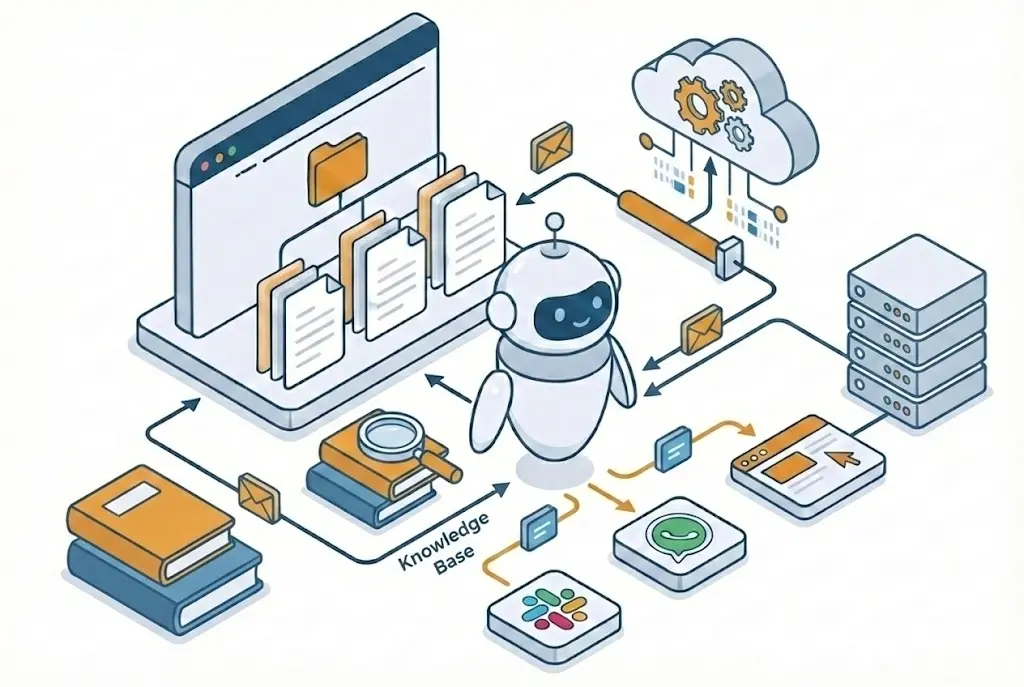
Agentic Knowledge Assistant
An LLM-powered, multi-channel assistant that uses Retrieval-Augmented Generation (RAG) to autonomously answer employee o...
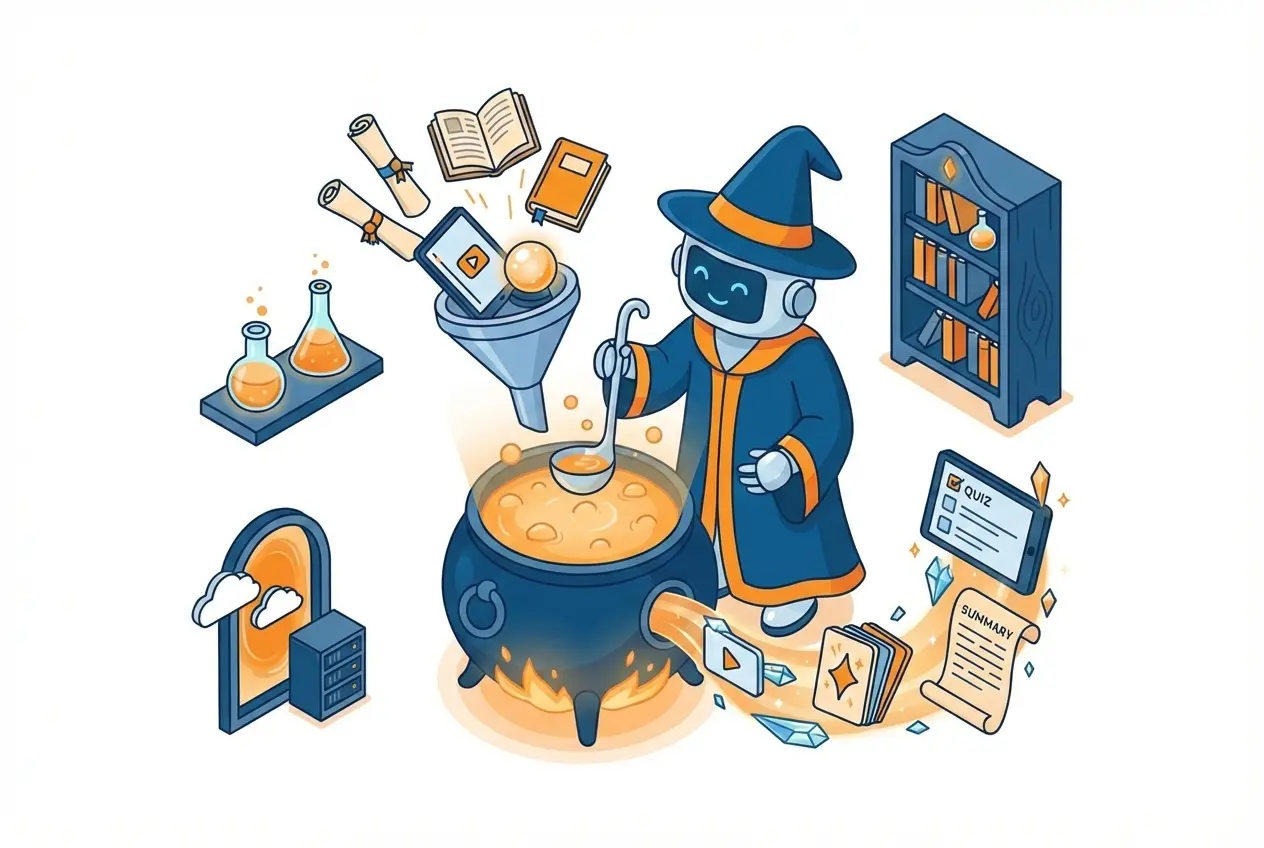
Autonomous Content-to-Learning Engine
An AI system that ingests PDFs, videos, or documents and autonomously creates assessments, flashcards, and learning summ...
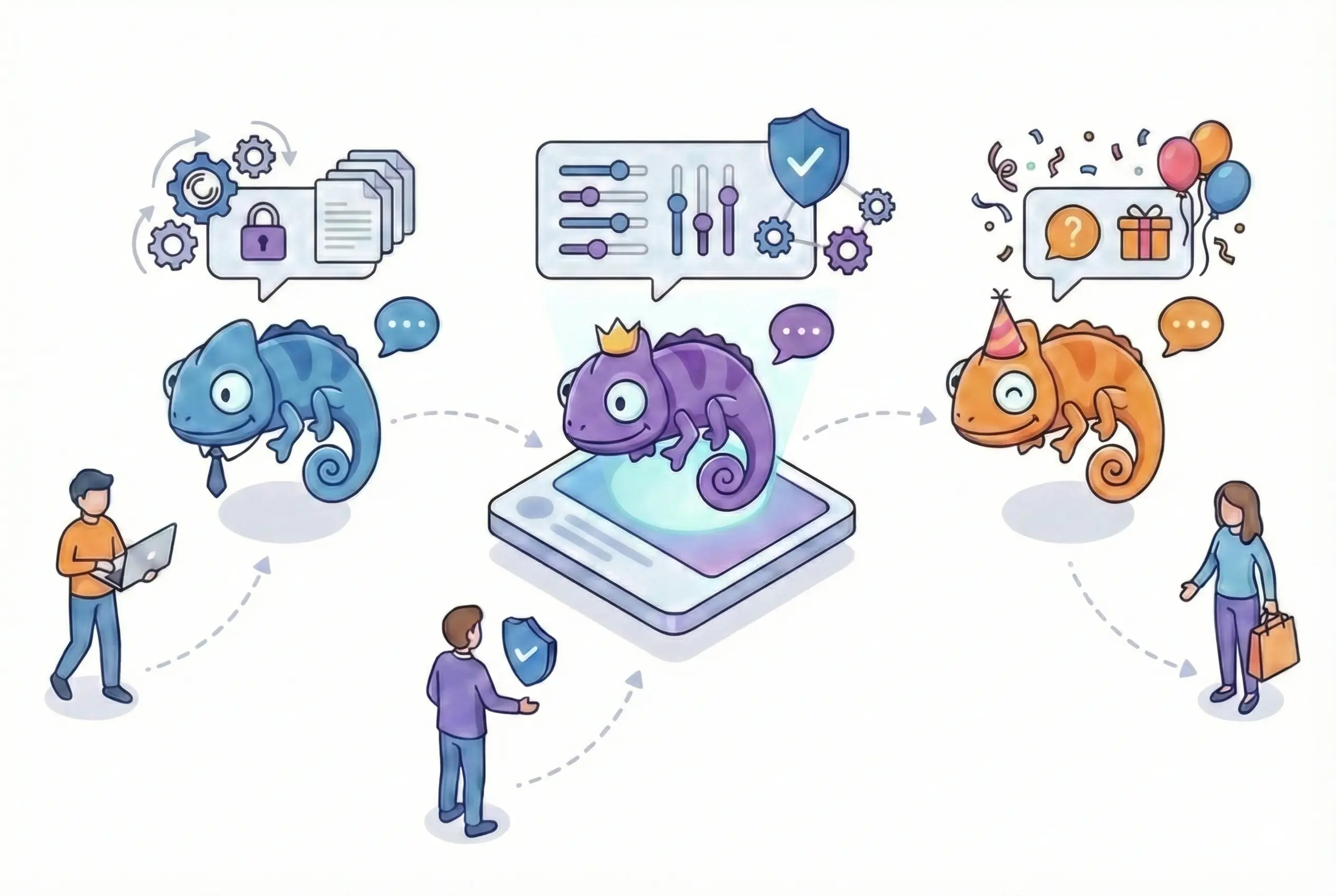
Embeddable Role-Aware Chat Widget
A lightweight AI widget that plugs into any platform and adapts answers dynamically based on user role and platform cont...